Friday, April 25, 2014

APOD 4.5

See Explanation.  Clicking on the picture will download
 the highest resolution version available.

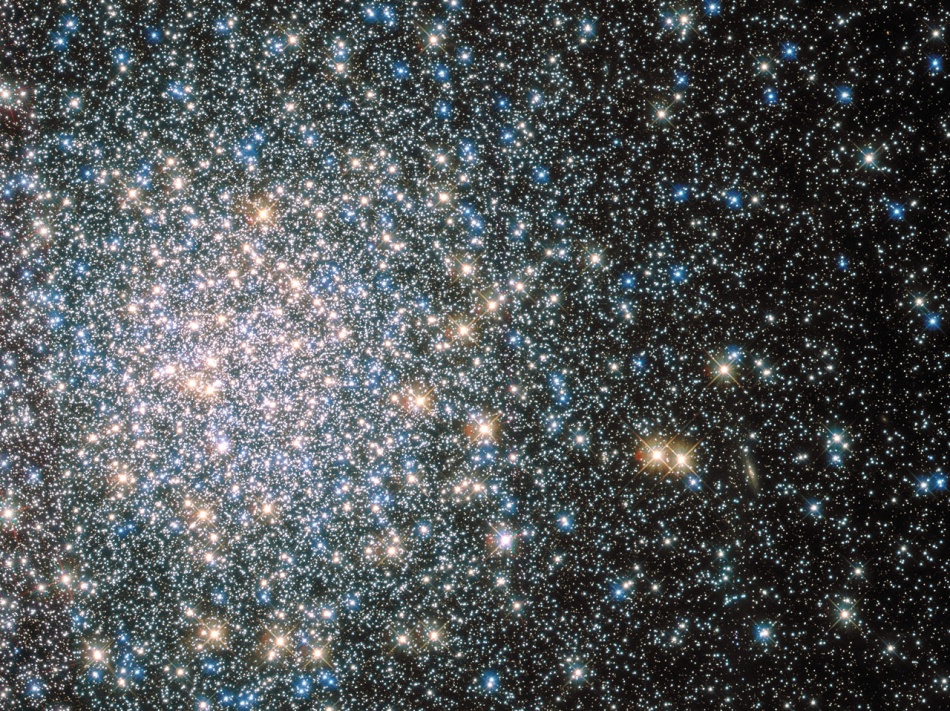
This week's APOD shows Messier 5, a globular star cluster located between the constellations Libra and Serpens. This globular cluster was thought to be a nebula, discovered by 18th century astronomer Charles Messier. It contained more than 100K stars, bound together around a 165 light-years in diameter length. According to this APOD, M5 is one of the oldest globulars in the milky way. I chose this photo for this week's APOD because we have studied the constellations Libra and Serpens so I found it interesting to learn about a new M object located between both. I also found it incredibly interesting that  in the 18th century, so long ago, Messier was able to observe this cluster with the naked eye or telescope. 


Thursday, April 17, 2014

APOD 4.4


See Explanation.  Clicking on the picture will download
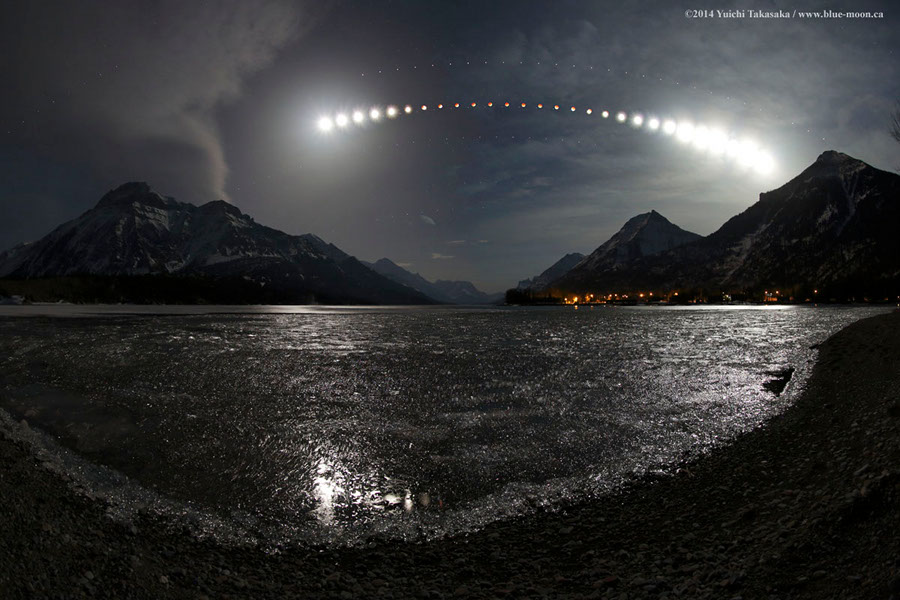
 the highest resolution version available.The APOD that I chose for this week depicts the recent lunar eclipse seen over from the chilly Waterton Lake in Waterton Lakes National Park in Albert, Canada. Recently, we have been working with a lot of astronomy photography and it is something I have grown to understand and become interested in more. In this photo of the lunar eclipse, there is an exposure of 10 minutes which allowed for the capture of the moon's eclipse phase's position over a period of 80 minutes.The photograph also depicted the star Spica from the constellation Virgo. Something interesting that I learned from this entry was that as early as 270 BC, a greek astronomer by the name of Aristarchus measured the duration of a lunar eclipse. I find it awesome that someone in such an early civilization could do that without the aid of modern clocks and cameras but rather algebraic math.


Tuesday, April 8, 2014

Contributions to N + S of Milky Way

Galileo: Galileo observed the Milky Way, which was previously believed too be nebulous, He found it to be a magnitude of stars packed extremely dense instead of what people thought to be simply nebulas.
William Herschel: Helped establish the shape of the milky way with the large telescopes. He helped establish that we in fact live in the milky way and that the fuzzy patches observed were nebulae. By measuring the stars, he helped establish that we live in what he called a disk of stars. 
Harlow Shapley: Helped expand our knowledge on the shape of the milky way. He began by studying globular clusters around the time when the shape of the galaxy was unknown. But after his research was published, the shape and the position of our solar system in the galaxy was known. 


Edwin Hubble: He helped understand that the cloudy patches observed were not nebulae but other nearby galaxies. This helped understand the size of the universe. He also helped by stating that the universe was in fact expanding.
Immanuel Kant:  Believed the milky way was disk shape but never achieved much work on it.
Henrietta Leavitt: Discovered the period luminosity relation.

The Great Debate: Between Curtis and Shapley, Shapley held the position that the spiral nebula we call galaxies were inside the milky way. Curtis argued they were outside.

Tuesday, March 18, 2014

The end of a high mass star: Pulsars and Neutron Stars

Like we have learned in class, many of the stars found in the universe have similar properties to our own star, the sun. However, some stars are different and like we learned in the star formation unit and these stars are of high mass. These special stars are destined to end in supernovas. Compared to our sun they are 10x heavier and 4x as large. Due to this high mass, their fuel is burned at a greater rate, in about 10 million years. One can put into perspective this with our own sun whose hydrogen will  burnt out after 10 billion years, the difference is clear. When this happens to our stars like our sun, they become a white dwarf: small, dense, and whose temperature cools down eventually. These high mass stars on the other hand no longer support the outward pressure that balances with their inward gravitational pull its immense mass requires. Compared to the slow and calm death of the other stars, the death of this high mass stars becomes much more dramatic. The core shrinks, burns up in temperatures to about 100 billion degrees and becomes more dense with the iron atoms crushing together. This dramatic explosion of energy lead to a shocking wave that expands to about 1 billion kph. This is the death of the high mass star, this is a supernova.  The material pushed away by the explosion forms into a ring shape known as the supernova remnant. What remains from the original high mass star in a much smaller dense core of only neutrons, known as a neutron star. If the neutrons radiate, a pulsar forms. However, something else could happen. If the original high mass star was greater than 15x the sun, the neutrons would not survive the collapse of the core and the stars would become black holes.

The following diagram, visually demonstrated the life cycle of a high mass star:


Friday, March 14, 2014

APOD 3.8

This week's APOD is titled Glubules in the Running Chicken Nebula. The title was interesting so that's why I picked. This nebula is named after it's shape. The image was taken from an observatory in Australia called the Siding Spring Observatory. The globules in the nebula are called Thackeray's Globules (pictured below). These globules referred to as egg are potential sites for the gravitational condensation of new stars. I thought this was a pretty since we just recently learned about the formation of stars so I  understand how it occurs. I also decided to choose this APOD because I was able to see the chicken head and found it amusing. I am also intrigued by the visualization of nebulas in photos. I find it very impressive we can see them and photograph them with the telescopes we have.


Friday, February 28, 2014

APOD 3.7


This week's APOD of the week for the date of 27 February depicted is titled Daytime moon meets morning star and depicts that exactly. What it depicts is something we have been told in class and something I have been able to observe in the morning skies. It shows venus as the brightest object in the early morning and it is seen as if it were a star. I think this picture for one was very interesting and it gave a nice viewpoint of what we see. I liked the way it was presented with the colors and of the clear crescent shape. My favorite part of this picture is that is clear to the naked eye from Africa and I find it awesome that we as humans have that opportunity to simply look up and observe our universe.

Friday, February 21, 2014

APOD 3.6

See Explanation.  Clicking on the picture will download
 the highest resolution version available.


The APOD I chose for this week from above depicts the lighthouse nebula. I chose it because we have been learning about nebulas in class and thought I might as well try to learn a few. This nebula was forms from the wind of a pulsar, rotating around with the speed of over 1000 km/second. This is something I found incredibily impressive.