Friday, February 28, 2014

APOD 3.7


This week's APOD of the week for the date of 27 February depicted is titled Daytime moon meets morning star and depicts that exactly. What it depicts is something we have been told in class and something I have been able to observe in the morning skies. It shows venus as the brightest object in the early morning and it is seen as if it were a star. I think this picture for one was very interesting and it gave a nice viewpoint of what we see. I liked the way it was presented with the colors and of the clear crescent shape. My favorite part of this picture is that is clear to the naked eye from Africa and I find it awesome that we as humans have that opportunity to simply look up and observe our universe.

Friday, February 21, 2014

APOD 3.6

See Explanation.  Clicking on the picture will download
 the highest resolution version available.


The APOD I chose for this week from above depicts the lighthouse nebula. I chose it because we have been learning about nebulas in class and thought I might as well try to learn a few. This nebula was forms from the wind of a pulsar, rotating around with the speed of over 1000 km/second. This is something I found incredibily impressive.

Friday, February 14, 2014

APOD 3.5

See Explanation.
Moving the cursor over the image will bring up an alternate version.
Clicking on the image will bring up the highest resolution version
available.


This weeks APOD is titled Downtown Auriga which I chose to learn more about the constellation Auriga which we have to learn about for our constellation quizzes. This APOD entry depicts a deep telescopic mosaic view of the constellation while showing off Auriga's most popular sights for cosmic tourtists. This picture was taken in january. From the persepective of the picture, the zodiacal constellation of Taurus the Bull can be seen near the bottom. I enjoy choosing APOD which give me a new more realistic viewpoint of the constellations we learn so I can know what they look like beyond the bright dots I can only see with my naked eye.

Friday, February 7, 2014

APOD 3.4

See Explanation.  Clicking on the picture will download
 the highest resolution version available.


This weeks APOD I chose depicted above shows a panoramic viewpoint of the moon from the perspective of the Chinese Yutu robotic rover. This robotic rover arrived in mid-december of 2013 and has been exploring Mare Imbrium on the moon. The reason I chose this APOD is because i did not know what Mare Imbrium was. In Latin it means  sea of showers or sea of rains and it is a large lunar mare on the moon. Apparently, it is one of the larger craters in the solar system. Its origin is said to come from a flood of lava. Depicted below is the extent and location of the mare imbrium. I am glad I know now one more fact about the moon's surface.

Imbrium location.jpg

Friday, January 31, 2014

APOD 3.3

The APOD I chose for this week comes from the entry put in on Jan. 31 titled, "Light Pillars from a Little Planet" in which this interestin photograph gives an interesting viewpoint of what one can hardly believe to be planet earth. The photograph is a sphereical panoramic image  from the viewpoint of eastern finland. What is the most interesting thing about this photo and gives the title to the beautiful image are the pillars of light reflected from the crystals. The reason I chose this image is because I enjoy whenever the APOD image entries create a new viewpoint with the collaboration of astronomy's reach and the potential of changing photography.


Friday, January 24, 2014

APOD 3.2

The APOD for this week that I chose depicts the double cluster celestial object found in the Perseus constellation. I chose it because I remember the Perseus constellation from the weekly quizzes and I also remember it is Mr. Percival's favorite constellation. This picture goes under the category of Astrophotography which I also thought was pretty cool. This APOD entry says that this starfield stretches seven full mons (3.5 degrees) across Perseus, which I think is pretty impressive because I was not aware of its massive extension. One thing I learned about the clusters themselves is that they are 7000 light years away and the stars are much hotter and younger than the sun. The entry also speaks about the clusters' age which are around 13 million years old. The most interesting thing I found about this entry was that the cluster is apparently visible to the naked eye under the right conditions. I hope to be able to identify it as I continue to look up and observe the skies.

Friday, January 17, 2014

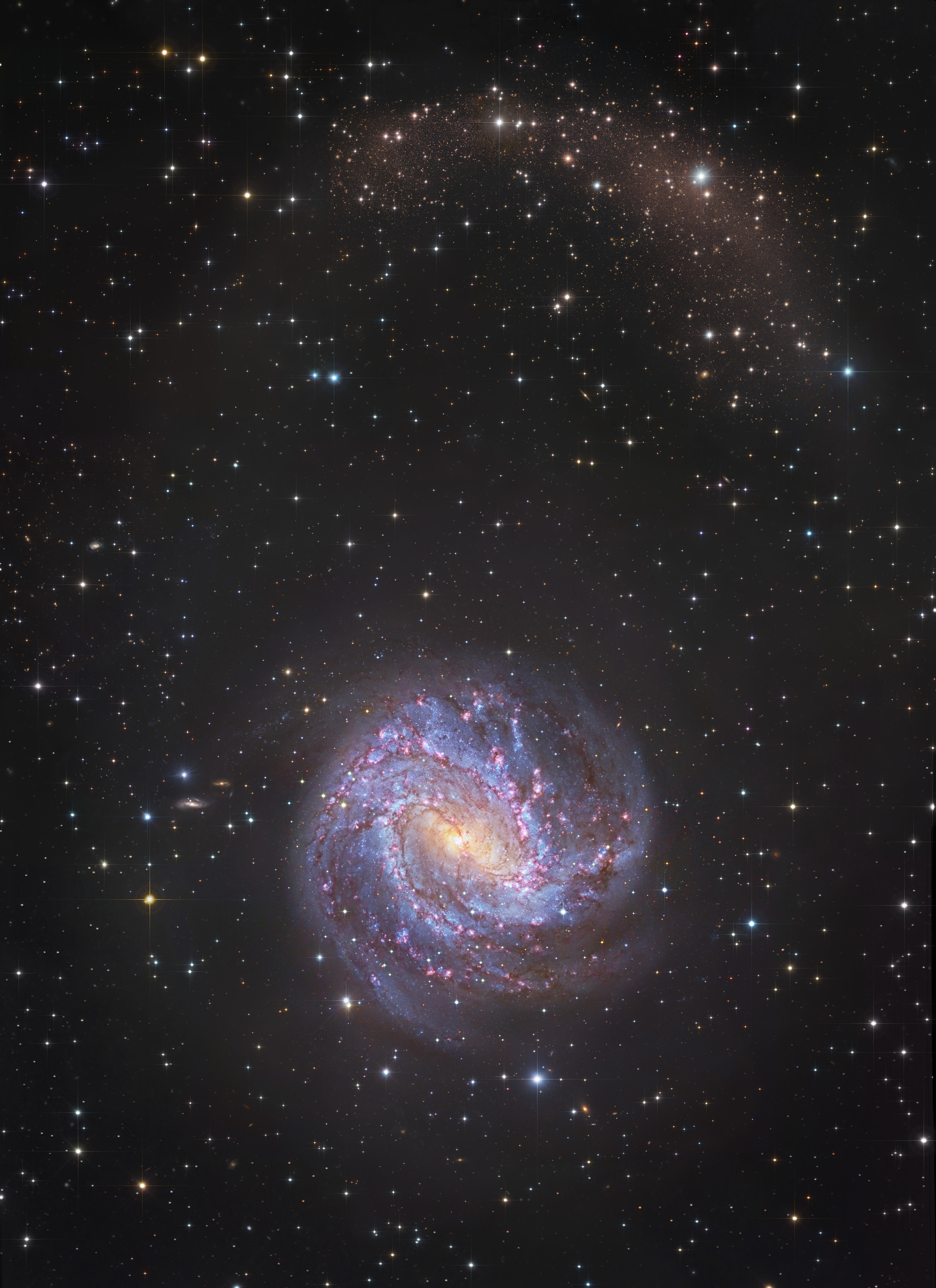
APOD 3.1

The APOD for this week that I chose is titled M83 Star Streams. To be honest, I chose it because I know it is the title of an indie-pop band and I never realized it was named after an M object. I think this galaxy is very interesting looking and according to the entry it lies a mere twelve million light-years away, near the southeastern tip of the very long constellation Hydra. The M83 Star Streams pictures were gathered by the Hubble Telescope and date from a european telescope from the European Southern Observatory. I learned that M83's northern stellar tidal stream is actually debris from the gravitational disruption of a smaller, merging satellite galaxy.